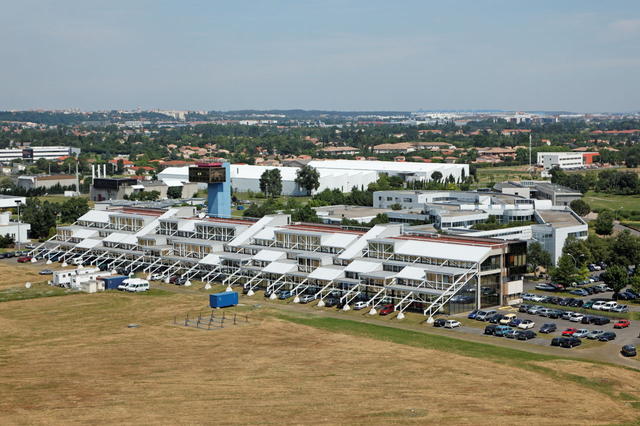
The National Center for Meteorological researche (Centre National de Recherches Météorologiques – CNRM) is a research unit (UMR 3589) established by Meteo-France and the CNRS. Its research activities are mainly carried out at Meteo-France’s facilities in Toulouse, Grenoble and Lannion.
The CNRM mainly conducts research aimed at improving our understanding of how the atmosphere and its interfaces function (continental and oceanic surfaces).
These studies are based on approaches founded in particular on in-situ or satellite observation and numerical modelling, and the development of weather forecasting and climate modelling systems. The research conducted at CNRM is essential for improving the operational capacity to monitor and anticipate meteorological phenomena at all scales of time and space, in the context of climate change and its many manifestations. CNRM’s work responds to societal needs and expectations in terms of decision support in the field of meteorology and climate.
The operational transfer of CNRM research results takes place within the framework of close dialogue with Météo-France’s thematic departments. The laboratory also maintains numerous scientific collaborations, notably with the laboratories of the Midi-Pyrénées Observatory (OMP), the Grenoble Observatory of Universe Sciences (OSUG), the Observatoire des Sciences de l’Univers de La Réunion (OSUR), and the Institut Pierre-Simon Laplace (IPSL), as well as other laboratories and organisations in France and internationally, in particular the European Centre for Medium-Range Weather Forecasts (CEPMMT) and the European consortium ACCORD for the development of limited-area forecast models.
The CNRM employs around 400 people, including more than 100 researchers from Météo-France and the CNRS, 150 permanent research support staff (Météo-France and CNRS), around 100 fixed-term contract staff (including post-doctoral researchers) on research contracts, and around 50 doctoral students (approximately 20 theses per year).
The CNRM produces around 200 scientific publications per year in peer-reviewed scientific journals, in addition to its major involvement in the continuous improvement of Météo-France’s forecasting tools and its support for the development of climate services.